
11juin
13juin
C.S. Lewis 2026 - War, Fellowship, and Survival in the Lives and Works of C.S. Lewis and Kindred Spirits
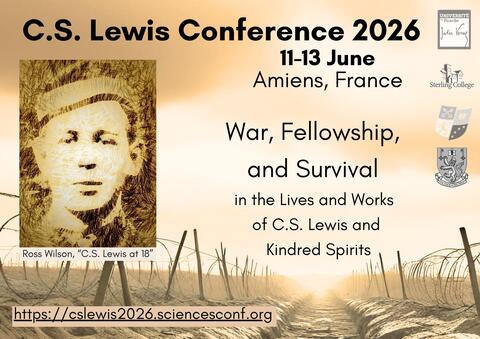
International Conference on War, Fellowship, and Survival in theLives and Works of C.S. Lewis and Kindred Spirits
June 11-13 2026, University of Picardie Jules Verne, Amiens, France.
We are pleased to announce a call for papers for an upcoming international conference on “War, Fellowship, and Survival in the Lives and Works of C.S. Lewis and Kindred Spirits”, to be held June 11-13, 2026 at the University of Picardie Jules Verne, Amiens, France.
During World War I, C.S. Lewis and some of his friends, like J.R.R. Tolkien, came to fight in the battlefields of Northern France. Lewis was in France from November 1917 to April 1918 and experienced frontline combat in villages near Arras (about 70 km North of Amiens). As for Tolkien, he fought in the Battle of the Somme from July to October 1916, in places situated less than 40 km away from Amiens. Both Tolkien and Warren Lewis (Lewis’s brother) spent some time in Amiens itself. It therefore seems appropriate to choose Amiens as the place to organize a conference on the theme of war and its consequences in the writings of C.S. Lewis and his kindred spirits.
Lewis’s experience in World War I heavily influenced his life and works. This can also be seen in the writings of other contemporaries like Tolkien’s The Lord of the Rings, or the works of Dorothy L. Sayers, whose fictional detective and war veteran Lord Peter Wimsey, suffers from PTSD. Yet, this aspect of Lewis’s work has not yet been given full critical attention.
Having served in the trenches, Lewis witnessed bodies literally being torn to shreds and his first reaction was to reject everything to do with materiality as a consequence. Later, however, he realized that matter should not systematically be associated with evil and he notably dealt with his trauma at least in part through his writings. War, either physical or spiritual, is a theme present in all his works, be it his fiction, apologetics, poetry, or essays. In his works the atmosphere is sometimes very dark —the patient dies because of a bomb in The Screwtape Letters, Ransom has to physically fight Weston to death in Perelandra, That Hideous Strength is a dystopia where dark forces try to take over the whole world. Even in the first volume of the Chronicles of Narnia, meant for young readers, the children leave one world where a war is taking place to join another one. However, unlike some of his contemporaries, Lewis did not let his distressing experience plunge him into cynicism or despair. Just like Tolkien, he refused to envisage irony as the only proper response to the war. Instead, he chose to render his experiences through mythopoeia, putting into practice Tolkien's theory that one of the functions of fantasy is Escape. Escape, unlike escapism, does not mean to flee from the real world, but to be able to distance yourself from the mundane and to see things in a renewed light.
In the trenches, Lewis created bonds with people he hardly knew and who were very different from himself. He later portrayed fellowship as a source of strength in the face of adversity, for example in the Ransom Trilogy with the Company at St Anne’s. Tolkien’s Fellowship of the Ring is another powerful illustration of the same idea.
Lewis did not value physical survival as such and at any cost. However, the way he dealt with his traumatic experiences through his writings helped him to survive the war both morally and spiritually. Despite the horrors he witnessed and the losses he sustained, Lewis believed that war could be a formative experience, where virtues such as courage, loyalty, and sacrifice are brought to the forefront. By choosing to mythologize war and to relate it to heroic romance in his fantasies, he gave his experience a universal significance.
We welcome papers on war and its consequences in C.S. Lewis’s and his kindred spirits’ writings. World War I will be given special emphasis but papers can also deal with World War II, which is a prevalent background and source of inspiration in numerous works by Lewis, Tolkien, Charles Williams and others, even if they did not physically fight in it. War can also be envisaged in more general terms, as a moral and spiritual battleground.
We invite scholars from all disciplines, including literature, history, theology, philosophy, and cultural studies, to submit proposals for papers. Conference presentations should be in English and will be allocated 20 minutes each.
